
Do you run a company and feel like you're drowning in chaos? You keep customer information in one Excel file, tasks for your team in Trello, invoices in another program, and warehouse stock somewhere else entirely? Every tool works on its own, with no integration, and you're wasting time switching between tabs and copying text. Does every business process come with new software you have to pay for and learn?
Imagine your company as a set of building blocks that should fit together. Each block is a different department and a different business process: sales, marketing, warehouse, projects. For a coherent whole to emerge, these elements need to work together perfectly. And that's exactly how Odoo works - it's a set of blocks that come together to support your business.
What is Odoo?
Put simply, Odoo is a central system for managing your entire company. One platform that replaces dozens of separate applications. It's a command center where you have access to everything - from customer contact (CRM), through project management, to invoicing and warehouse stock. In the world of technology, this is called an ERP system (Enterprise Resource Planning).
Odoo - a modular system
Odoo's greatest strength is its modularity. Going back to our building-blocks analogy - you don't have to build a castle right away. You can start with a small house.
Do you only need a professional website to start with? Great, install the "Website" module (by the way, creating and managing such a website is free) and you're done. Your company is growing and you want to let customers book meetings online? In a few clicks, you add the "Appointments" module - this module adds new capabilities to Odoo. In a matter of seconds you can add a public calendar to your site, where visitors can book a meeting. When the number of customers translates into a growing number of projects - Odoo offers the Projects module. Install it, and you get a tool for running and billing projects.
Full functionality
Odoo offers a range of modules that cover nearly all the needs of small and medium-sized businesses. Among these modules you'll find, among others:
- Document storage: One central place where all your documents live.
- Customer Relationship Management (CRM): No more losing contacts or forgetting to call clients back. All emails, notes, and sales opportunities are kept in one organized place.
- Warehouse control: You know exactly how much stock you have, where it's located, and when to reorder. The system can handle this automatically.
- Appointment and resource scheduling: Book resources such as tennis courts, restaurant tables, or conference rooms.
- Manufacturing: Full control over orders and work centers on the production floor.
- Project management: You always know the status of projects and individual tasks. You're in control of costs and progress.
- Point of Sale: Full point-of-sale support, from the fiscal cash register to managing restaurant tables.
- Online marketing tools: Manage your social media campaigns and automate email sending.
- And more... check it out here.
If you didn't find an answer to the question "could Odoo be useful for XYZ?" on the list above, the answer is most likely: YES!
As I mentioned earlier - the modules are fully integrated with each other! Everything is designed so that the solution helps you grow, and grows along with the company it's implemented in, and installing additional modules looks roughly like this:
Sample installation of the CRM module.
What I like most about Odoo
So far it's the Chatter and the Activities to be done, although it was hard to choose.
Chatter is a core Odoo feature that lets you keep communication and everything related to a task in one place. Thanks to this, you can immediately see the whole history and planned actions related to a given record in the database. Chatter is available in almost every module.
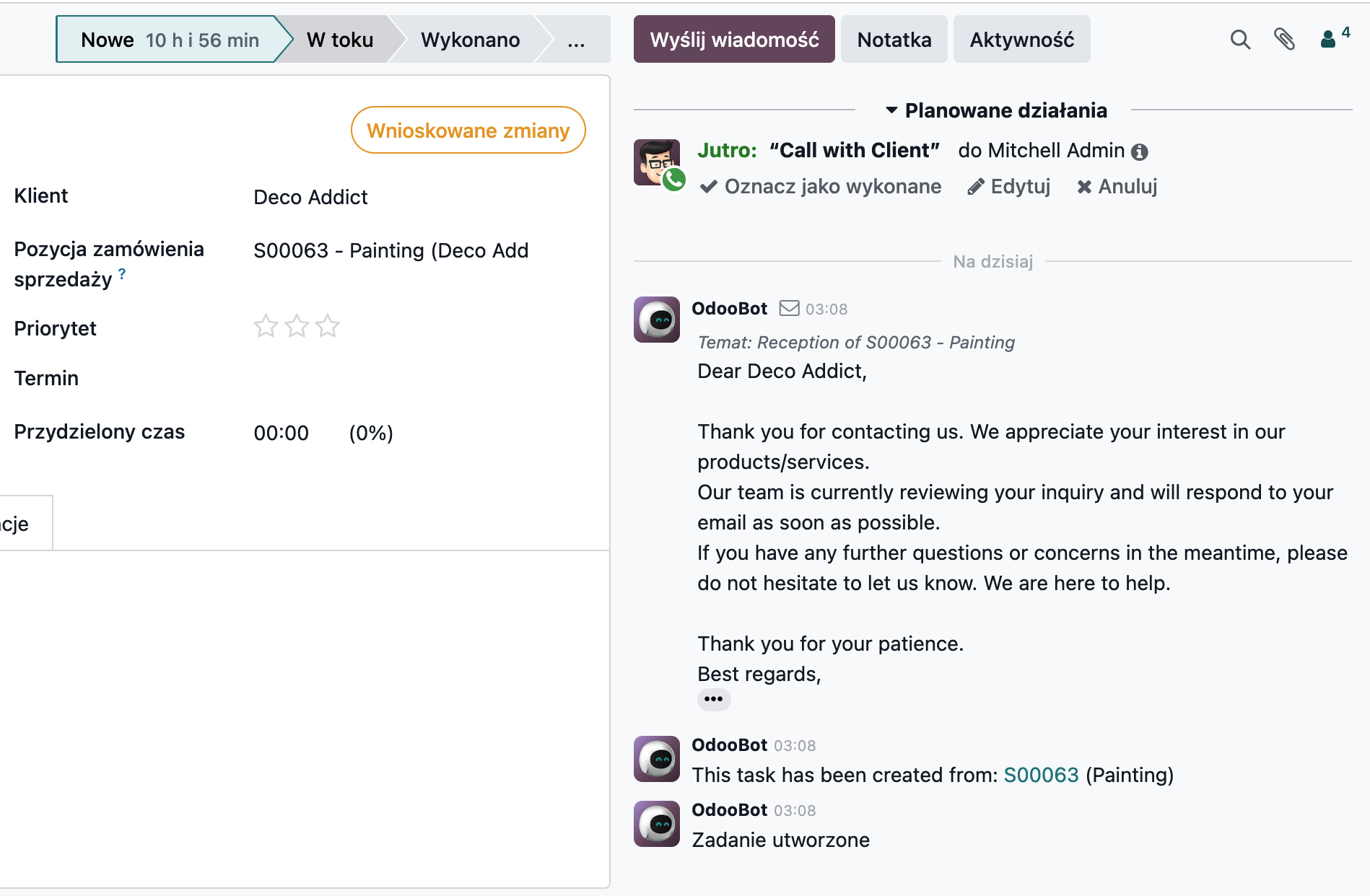 Example of Chatter from demo.odoo.com
Personally, I've always liked using software tools to help with projects and day-to-day work. This lets me reduce the number of things I have to remember and think about. I can focus on the task at hand. I used ClickUp and Trello, but Odoo offers me far more for a similar price. Far, far more. And don't get me wrong - for example, when it comes to documentation, ClickUp has a more advanced document editor than Odoo, but I definitely don't consider that a critical feature.
Summary
I hope this post has made it clearer what Odoo is and what it's for. It's not just software - it's a way to regain control of your company and focus on what matters most - its growth.
Have questions, or wondering whether Odoo would fit your business? Write to me or schedule a short, no-obligation call!